
Turkey Breeds
There are many turkey breeds available throughout the world. But not nearly as many turkey breeds as there are chicken breeds or duck breeds. Although, there are still enough varieties to choose from. Some of these breeds are good for commercial meat production purpose, some are good for enhancing beauty of your home, and some turkey breeds are good for raising as pets. For commercial purpose, most of the farmers used to raise turkeys for meat production.
Choosing the right turkey breed is an important decision that can have a significant impact on your success in commercial turkey farming business. Here in this guide, we are going to discuss about different types of turkey breeds with their characteristics and some best turkey breeds for many different purposes. Hope this guide will help you!
Why Choosing the Right Turkey Breed Important?
Choosing the right turkey breed is very important because it affects the production and profits from your farm. Different breeds have distinct characteristics (such as meat texture, flavor, and growth rate). And selecting a breed that goes well with your preferences and purpose, ensures good production and maximum income.
How to Select the Right Turkey Breed for Your Farm?
Selecting the right turkey breed for your farm is another very important task. You should select a good breed for your farm by considering your goals and resources. Determine your production purpose (whether you want turkeys for meat, eggs, or both). Consider your local climate and available space.
Broad Breasted White are excellent for meat, while Bourbon Red are heritage breeds and they are known for flavor. Try to learn about the bird's size, growth rate, and adaptability to your environment. You can also consult with some local experts while choosing best breeds for your farm.
Best 10 Turkey Breeds
Turkey breeds come in various sizes, colors, and characteristics, making them an ideal choice for backyard farmers, commercial producers, and hobbyists alike. Some of the most common turkey breeds are the Broad Breasted White, Narragansett, Bourbon Red, Royal Palm, Bronze, and White Holland.
The Broad Breasted White is popular for its large size and efficiency in meat production, while the Narragansett is known for its calm temperament and ability to forage. The Bourbon Red has a striking appearance and excellent flavor, while the Royal Palm is a small breed used for ornamental purposes.
The Bronze is a heritage breed with excellent meat quality and hardiness, and the White Holland is a popular choice for meat production and backyard farming. You should learn about various types of turkey breeds. Here we are shortly describing about some common and popular turkey breeds, with their characteristics.
1. Beltsville Small White Turkey
Beltsville small white turkeys were developed in the 1930s. They are similar in size as the Midget Whites. But Beltsville small white turkeys have wider breasts than the Midget Whites. Beltsvile small white turkeys make a nice table bird but are blander than Midgets or some other heritage birds. They are prolific layers and mature hens are good sitters and can hatch eggs well. Although, they are not very social compared to other heritage turkey breeds.

2. Black Turkey
Black turkey is a domestic turkey breed. It was domesticated from Mexican wild turkeys brought back to Europe by the first Spanish explorers who visited the USA. Black turkeys have been around since the 1500s and their plumage is black. This breed is available in many European nations.

3. Blue Slate Turkey
Blue slate is a domestic turkey breed. They have slate gray color plumage. They are lighter birds and are also sometimes called Lavender turkeys. Actually slate turkey breed may be any number of shades between white and pure black. They are among the beautiful heritage turkey breeds. Adult Blue Slate hen can weight about 14 pounds and an adult tom can weight about 23 pounds.

4. Bourbon Red Turkey
Bourbon Red turkeys are very attractive birds for their beautiful red plumage. They are also known and popular for a full flavor, delicious meat and are considered as one of the best tasting heritage turkey breeds. This breed came from their origin in Bourbon county, Kentucky. They were first bred there during the 1800s. A mature Bourbon hen weights about 12 pounds and a mature tom can reach about 23 pounds.

5. Broad Breasted White Turkey
Broad Breasted white turkeys are modern turkey breed which are raised commercially in farms. They are available in almost every country around the globe. They have maximum conversion ratio of feed to meat in shortest possible time (like broiler chicken breeds) and very suitable for commercial turkey farming business. Although, there are some problems with Broad-Breasted white turkeys. They can't fly or walk. They are prone to diseases like other factory farm raised poultry birds and they can't reproduce without artificial insemination. They also don't taste too good like other turkey breeds. They are only suitable for factory farm production purpose.
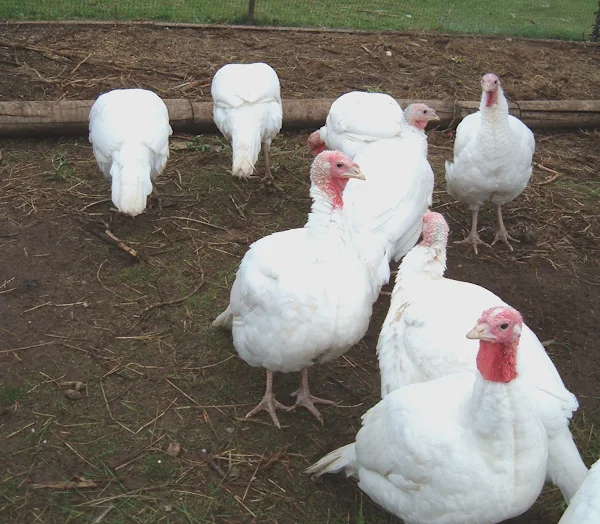
6. Midget White Turkey
Midget White turkeys are relatively a new heritage breed. Researchers at the University of Massachusetts developed this turkey breed in the 1960s. They are a cross of Broad-Breasted whites and Royal Palm. They are smaller in size and are known for their deep, delicious flavor. Midget White turkeys are calm in nature and do well raising poults (because the Midget White hens are small and they can become good fence-jumpers). A mature Midget White hen weights about 8 to 12 pounds and a mature tom weights about 16 to 20 pounds.

7. Narragansett Turkey
Narragansett turkeys were the staple of the New England turkey scene before factory farmed turkeys became the norm (they are originally from Rhode Island). On an average, mature Narragansett hens weight about 18 pounds and toms weight about 30 pounds.

8. Standard Bronze Turkey
Standard Bronze turkey is one of the largest heritage turkey breeds. They have also been the most popular turkey breeds in American history. Bronzes were originally a cross between the native wild turkeys (discovered by Europeans) in America and the turkeys brought to the colonies by Europeans. Among the Standard Bronze varieties, the Broad-Breasted Bronze is the most commercially raised variety and most have been bred by artificial insemination since the 1960s. But this variety was replaced by the Broad-Breasted White at that time.
Because white feathers of Broad-Breasted White turkeys led to a cleaner looking and they become most commercially acceptable turkey breed. On an average, an adult hen weights about 16 pounds and a tom can reach about 25 pounds. Although birds which are available nowadays may be smaller than this.

9. Royal Palm Turkey
The Royal Palm turkey is a very beautiful, striking turkey breed. Actually, they were bred for their good looks. They have white and black plumage. They were breed not for commercial purpose. Because they are smaller in size than most other heritage varieties. They are mostly raised for exhibition or enhancing beauty of home or farm.
Although, they are suitable for meat production for family consumption purpose. Royal Palm are active turkey breed that forage extensively, they can control insects well and are also good flyers. Royal Palm hens weight about 10 pounds and toms weight about 16 pounds.

10. White Holland Turkey
White Holland turkeys were bred in Holland. This turkey breed migrated to the USA with early settlers to the country. And they were popular as meat bird in the 1800s. White Holland turkeys are calm in nature and good setters and mothers. But they sometimes break their eggs because the hens are so heavy. A mature White Holland hen can weight up to 20 pounds and a mature tom can weight up to 30 pounds.

Hope this guide has helped you. Consider sharing it with your friends and family members if you find it helpful. Good luck and may God bless you!
 Reviewed by Tanmoy Roy
on
January 10, 2015
Rating:
Reviewed by Tanmoy Roy
on
January 10, 2015
Rating:
Post a Comment